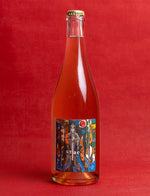
Crac Rosé 2021
Fresh, fruity, and pleasant, Crac is a vin gris, a still rosé wine made entirely or partially from black grapes. It generally undergoes a very short maceration, hence its light color. This is obtained by slow direct pressing (forty-eight hours) of Auvergne Gamays "sur limagne," or on the dark-colored sedimentary and volcanic soils that make up the Auvergne plain. This slow pressing, replacing a short maceration, allows for a gentle extraction of the grape's constituents and gives the wine its color. To these Auvergne Gamays are added a proportion of Pinot Gris from Alsace. Categorized as Vin de France, free from any chemical or sulfite additives in the vineyard or in the cellar, Crac spends a year aging on lees before bottling. This wine is produced using organic farming methods and has received no chemical or sulfite additives, in the vineyard or in the cellar. It will go very well with charcuterie, cured meats, and tapas of all kinds.
To find out moreFounded and run by Claire Sage and Aimé Duveau, located in Chanteuges (Haute-Loire), Belly Wine Experiment is as much an experiment as it is a winemaking business. The creative duo has a lot to offer: Claire is the sister of Daniel Sage, a fan of underwater wine aging but above all an importer of Catalan wines. Hence the presence of Catalan grape varieties in Belly Wine Experiment's blends, alongside Burgundy, Auvergne and Jura grape varieties, readily found in the same bottle. Aimé is the son of Manu Duveau, a poet-winemaker from Auvergne, a former stonemason and a great winemaker of local Gamays at his Domaine de l'Égrappille. The specificity of Belly Wine Experiment is the exoticism (in the literal sense) of the blends, with Xarel lo from Catalonia being able to rub shoulders, for example, with Gamay from Puy-de-Dôme with the utmost naturalness. The wines are made using semicarbonic maceration, without the addition of chemical additives or excessive manipulation in the cellar. The house is also known for its very high-quality, vinous perries.