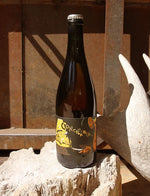
Es d'aqui Conciliabule Rosé Pétillant 2020
A joyful, lively, fruity, and festive wine that will be wonderful as an aperitif. Conciliabule is a beautiful sparkling natural rosé made from Pinot Noir from Castelreng, grown on the clay-limestone terroirs around Limoux. The harvest undergoes direct pressing followed by four months of aging on slats and a free-flowing disgorgement.
To find out more
A child of Ariège, Jean-Louis Pinto chose to stay in the region and make wines that resemble their terroir, hence the name Es d’Aqui (“It’s, it’s from here”) that he gave to his winemaking business, located in Moulin-Neuf, a commune near Aude, between Mirepoix and Limoux. A region where vines once abounded, until the major mildew attacks at the beginning of the 20th century. Jean-Louis buys grapes grown organically by other winegrowers, his friends, in whom he has complete confidence. He doesn't just buy the product, he monitors the fruit set, the ripening, and makes regular visits until August, in order to know the grapes before harvesting them. He vinifies them at home using natural methods, practicing long macerations on whole bunches. The three-week maceration is common at his place, as well as very gentle pressings in a vertical press. He has, he says, "a lot of vines in common" with his friend Anthony Tortul (
La Sorga). His collection area extends throughout the Languedoc, and particularly in the Hérault, around Adissan, Faugères and Saint-Chinian, as well as in the Aude (Limoux) and the Tarn (Gaillac), two terroirs that are dear to him. It turns out that the typical Languedoc soils – schist, basalt, pebbles, clay-siliceous – particularly appeal to him for the freshness they give to the wines. “I make wines from the South,” he says. “I mainly look for terroirs that give freshness, even if the wines are 14% alcohol.” The grape varieties are, of course, typically Languedoc: Grenache, Carignan, Mauzac, Cinsault, Braucol, Duras, and Sauvignon. The most powerful reds are made in five terracotta jars, which help him control extraction and give his wines, he says, “a very crystalline quality.” The soil, the location, as you can see, are of the utmost importance to him: once again, the name of his estate, Es d’Aqui, was not chosen by chance.