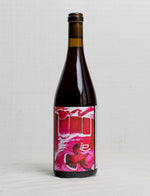
Jaen Touriga Encruzado Red 2021,
It's all in the title: Jaen Touriga Encruzado is made from the red grape varieties Jaen and Touriga on the one hand, and Encruzado and Cerceal on the other, all characteristic of the Portuguese wine region of Dão where this red wine is produced. The blend, vinified by Hugo Pinheiro and Florian Tonello in Penalva do Castelo, possesses the richness of a red wine with the fluidity provided by the white grape varieties. This results in a sumptuous gurgling of a vermillion color, deliciously crisp and full of sap. On the palate, it is well balanced between body and lightness, fruitiness and acidity, offering sweet notes of red fruits and blackcurrant. The tannins are nicely melted, giving a supple and velvety texture.
Jaen, the equivalent of Mencia in Spain, is a red grape variety frequently grown in the Dão, although it is tending to fade away because it requires a lot of attention. Fragrant and fruity, it deserves to be preserved. Touriga Nacional is a quintessentially Portuguese grape variety and one of the country's main grape varieties, even playing a key role in port blending. It is a dark-colored bunch, with small grains and a low yield. It produces full-bodied and balanced wines with notes of black fruits and flowers.
These two grape varieties represent half of the blend, the other half being made up of Encruzado and Cerceal, local white grape varieties of great delicacy, known for producing exceptional white wines. They are used here to add to the fluidity of the red wine. The vines, around thirty years old, grow on granite and clay-sand plots facing south at an altitude between 420 and 460 meters. The harvest is destemmed and, depending on the color of the grapes, receives a different treatment: the red grape varieties macerate for 5 or 6 days under slow pressing in a concrete vat. The white grape varieties go through direct pressing. Fermentation, using indigenous yeasts, takes place in stainless steel vats which are blended before bottling. After malolactic fermentation, aging lasts ten months. No filtration, no chemical inputs in the vineyard or in the cellar.
To find out more
The duality of the name Ladidadi/Pinheiro is simply due to the fact that this winemaking entity is the result of a friendship: that of Florian Tonello, creator of the Ladidadi Wine brand, wine merchant-DJ-globetrotter who devotes his life to making natural wines known and loved, and Hugo Pinheiro, winemaker at the head of a small estate of two and a half hectares in Penalva do Castelo, district of Viseu, Dão appellation (central Portugal). Together, they decided to produce several vintages of natural wines, obtained through organic farming, manual harvests, fermentation with indigenous yeasts, without filtration or the addition of sulfites, from the emblematic grape varieties of the appellation on an estate planted around thirty years ago, with a small part planted in the 1980s. We therefore find Touriga Nacional as the main grape variety in red, followed by Clarete, Jaen and Encruzado, and in white Malvasia, Cerceal, Bical and Terrantez. Vibrant, lively wines, and a great opportunity to discover Portugal's wine-growing region in natural mode.