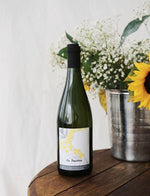
La Bueilloise Blanc 2022
La Bueilloise is a dry white sparkling wine from the Coteaux du Loir, classified as Vin de France, organic (Ecocert), and natural. It is produced by Renaud Guettier of La Grapperie, without the addition of sulfites or any other chemical additives. A fine example of this winemaker's expertise, with added bubbles.
Vinification
La Bueilloise is a blend of young and old Chenin Blanc (60%) and Pinot d'Aunis (40%) vines, pruned in goblet and crescent shapes on a flint-clay terroir. The oldest vines are 115 years old and the youngest 8 years old. The harvest is carried out by hand at full maturity. Spontaneous fermentation in fiberglass vats using indigenous yeasts for one month, followed by fermentation in bottles where aging continues for twelve months on the lees. Manual disgorging without the addition of preservatives, then recapping.
Tasting
The atypical blend of La Bueilloise is based on the majority of Chenin, ripe to the point, which brings its roundness, aromas and liveliness. The Pineau d'Aunis brings a slight bitterness. Dry and nuanced, sending out clouds of aromas in bursts, this wine offers lively and intense bubbles. Fresh apple, pear, minerality, dryness, straightforwardness. An aromatic and refreshing sparkling wine, which you can pair with a wide range of good things and not necessarily "white wine" products: it will go well with local charcuterie, fresh veal and pork, raw or cooked shellfish (scallops) and crustaceans, lobster or fish in sauce, and fine sweet or savory flaky pastries. It is the perfect companion to a good blanquette or salmon with beurre blanc.
Learn more about Renaud Guettier and La Grapperie
In the Coteaux du Loir appellation, La Grapperie is the name of the estate of Renaud Guettier, who can be described as a master of Chenin, but also of Pineau d'Aunis, which is one of the oldest grape varieties in the Loire Valley.
The estate
Renaud's 60 hectares of hillside vines are protected from the north winds by the Bercé forest. Depending on the altitude, the terroirs are predominantly clay, flint, or sand. The grape varieties are the two traditionally authorized in the appellation: Chenin for the whites and Pineau d'Aunis for 90% of the reds, the rest consisting of a few ares of Côt, Gamay and Grolleau. Some vines are more than a hundred years old.
In the vineyard and the winery
The entire estate is cultivated organically. The soils are worked and all viticultural interventions are manual, including the harvest, carried out at full maturity, which is reflected in the fullness and smoothness of the wines. For the reds, the Pineau d'Aunis is partially destemmed (depending on the plot) and the macerations are quite long, three to four weeks, with punching down, to promote aging potential. The wines are aged in barrels for between twelve and twenty-four months, then racked, blended and bottled without filtration. For the whites, the Chenins are pressed directly at low pressure then put into barrels with complete malolactic fermentation, for at least eighteen months, malolactic included, and sometimes up to thirty-six months.