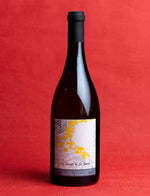
The Saint Pierre Blanc Press 2020

La Grapperie

Out of stock

Organic and natural dry white wine made from Loire Chenin, complex, fruity and voluptuous.

Victim of its own success!

Try these gems instead:

France - Loire Valley

14.0°

Grape varieties:

Capacity: 75 cl

Vintage: 2020

Learn more about the bottle:

Le Pressoir de Saint Pierre Blanc 2020

La Grapperie


Le Pressoir de Saint-Pierre is a magnificent expression of Chenin Blanc, a grape variety that is the hallmark of the central Loire Valley region. On the nose, it reveals fruity and citrus aromatic treasures, and already a hint of smoke and flint that promises wonders. On the palate, it confirms with notes of white and yellow fruits (apricot, apple, peach, mandarin) and rare and splendid smoky, earthy, and siliceous accents. Its voluptuous texture will wonderfully envelop smoked fish, white meats, and mushrooms. The elegance and maturity of the wine reflect the old vines from which it comes, planted in 1935 on tuffeau, marl limestone and flint clay soils on the left bank of the Loire. Despite aging for twenty-four months in barrels, this wine has a low alcohol content and retains a very nice minerality. The harvest is processed directly by pressing and the aging is one year in barrels.

To find out more
In the Coteaux du Loir appellation, La Grapperie is the name of the estate of Renaud Guettier, who can be described as a master of Chenin, but also of Pineau d'Aunis, which is one of the oldest grape varieties in the Loire Valley. His principle, he confides, is "to produce complex, rich wines, with good aging potential and imbued with the minerality of their terroir." The vines are located on hillsides, between 60 and 120 meters above sea level, protected from the north winds by the Bercé forest. Depending on the altitude, the terroirs are predominantly clay (at the bottom of the slope), flint (mid-slope) or sand (on the higher ground). The 60-hectare vineyard comprises around fifteen plots. The grape varieties are the two traditionally authorized varieties in the appellation: Chenin for the whites and Pineau d'Aunis for 90% of the reds, the remainder consisting of a few ares of Côt, Gamay and Grolleau. The average age of the vines is seventy years, including almost two hectares of century-old vines and one and a half hectares of vines aged between sixty and eighty years. Convinced of the enormous potential that these old vines can bring to his vintages, Renaud undertakes meticulous work to restore the vineyard. The entire estate is cultivated organically. The soils are worked and all viticultural interventions are manual, including the harvest, carried out at full maturity, which is reflected in the fullness and smoothness of the wines. For the reds, the Pineaux d'Aunis are partially destemmed (depending on the plot) and the macerations are quite long, three to four weeks, with punching down, to promote aging potential. The wines are aged in barrels for between twelve and twenty-four months, then racked, blended and bottled without filtration. For the whites, the Chenins are pressed directly at low pressure and then poured into barrels by gravity. Fermentation takes place in barrels, on indigenous yeasts, with complete malolactic fermentation, for at least eighteen months and sometimes up to thirty-six months.

Delivery 48h to 72h (Metropolitan France)

Personalized advice and responsive customer service

Rare references and hard-to-find gems

Secure Payment

Learn more about the bottle....

Le Pressoir de Saint Pierre Blanc 2020

La Grapperie


Le Pressoir de Saint-Pierre is a magnificent expression of Chenin Blanc, a grape variety that is the hallmark of the central Loire Valley region. On the nose, it reveals fruity and citrus aromatic treasures, and already a hint of smoke and flint that promises wonders. On the palate, it confirms with notes of white and yellow fruits (apricot, apple, peach, mandarin) and rare and splendid smoky, earthy, and siliceous accents. Its voluptuous texture will wonderfully envelop smoked fish, white meats, and mushrooms. The elegance and maturity of the wine reflect the old vines from which it comes, planted in 1935 on tuffeau, marl limestone and flint clay soils on the left bank of the Loire. Despite aging for twenty-four months in barrels, this wine has a low alcohol content and retains a very nice minerality. The harvest is processed directly by pressing and the aging is one year in barrels.

To find out more
In the Coteaux du Loir appellation, La Grapperie is the name of the estate of Renaud Guettier, who can be described as a master of Chenin, but also of Pineau d'Aunis, which is one of the oldest grape varieties in the Loire Valley. His principle, he confides, is "to produce complex, rich wines, with good aging potential and imbued with the minerality of their terroir." The vines are located on hillsides, between 60 and 120 meters above sea level, protected from the north winds by the Bercé forest. Depending on the altitude, the terroirs are predominantly clay (at the bottom of the slope), flint (mid-slope) or sand (on the higher ground). The 60-hectare vineyard comprises around fifteen plots. The grape varieties are the two traditionally authorized varieties in the appellation: Chenin for the whites and Pineau d'Aunis for 90% of the reds, the remainder consisting of a few ares of Côt, Gamay and Grolleau. The average age of the vines is seventy years, including almost two hectares of century-old vines and one and a half hectares of vines aged between sixty and eighty years. Convinced of the enormous potential that these old vines can bring to his vintages, Renaud undertakes meticulous work to restore the vineyard. The entire estate is cultivated organically. The soils are worked and all viticultural interventions are manual, including the harvest, carried out at full maturity, which is reflected in the fullness and smoothness of the wines. For the reds, the Pineaux d'Aunis are partially destemmed (depending on the plot) and the macerations are quite long, three to four weeks, with punching down, to promote aging potential. The wines are aged in barrels for between twelve and twenty-four months, then racked, blended and bottled without filtration. For the whites, the Chenins are pressed directly at low pressure and then poured into barrels by gravity. Fermentation takes place in barrels, on indigenous yeasts, with complete malolactic fermentation, for at least eighteen months and sometimes up to thirty-six months.